

“George was always on a quest to get as far away as he could… I had the feeling that he maxed the planet out, looking for solitude.”
- Olivia Harrison
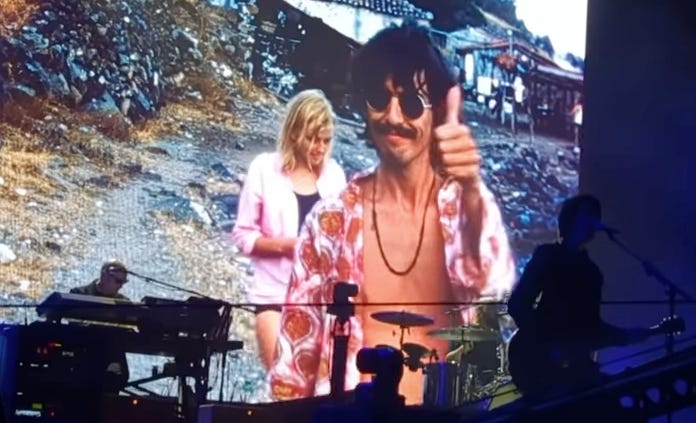
The Beatles’ attempt to buy a Greek island in 1967 is usually seen as John Lennon’s acid-fuelled fantasy, opportunistically seized upon by Magic Alex, and which the other Beatles just went along with. John was certainly the most enthusiastic. But there was more interest among the other three than is often assumed – something which becomes clearer if we look at George Harrison’s own lifelong interest in islands.
‘Eye of the hurricane’
George was the Beatle who seemed most affected by Beatlemania – which he later likened to being in “the eye of the hurricane”1. While the public “gave their money and they gave their screams,” Harrison said, the Beatles “gave their nervous systems, which is a much more difficult thing to give”.
In his 1980 memoir2, Harrison described the Beatles’ stay in Manila in 1966 – where they had to negotiate an angry mob following a perceived snub to the president’s wife – as “one of the nastiest times I have had”. He didn’t see the experience as an anomaly. Rather, it “relate[d] to the sort of life we were leading” – which involved the “awful” reality of “being on the front page of everyone’s life, every day”.
His familiarity with this “intrusion” led Harrison to prioritise peace and calm. “Your own space, man, it’s so important,” he says in the memoir. “That’s why [The Beatles] were doomed because we didn’t have any. It is like monkeys in a zoo. They die. You know, everything needs to be left alone.”
In the book, Harrison also contrasts the business side of his life – which is about trying to “spread more and more ripples until they become waves” – with his personal life, which, “having been all waves, has to change to a normality where I try to stop the waves, quieten them down to make myself a calm little pool”.
Hawaii and Hamilton Island
From the early 1980s, as Harrison’s desire for privacy intensified following the death of John Lennon, he sought out this calm on remote islands. He built a home on Maui, Hawaii, surrounded by a 60-acre clifftop estate where he spent hours gardening, and which one frequent guest described as “really hard to get to”3. George was remembered as kind and hospitable by a number of locals he employed. But as covered in the video report below, he got into a legal dispute with some neighbours concerning the use of a historic path through his grounds.
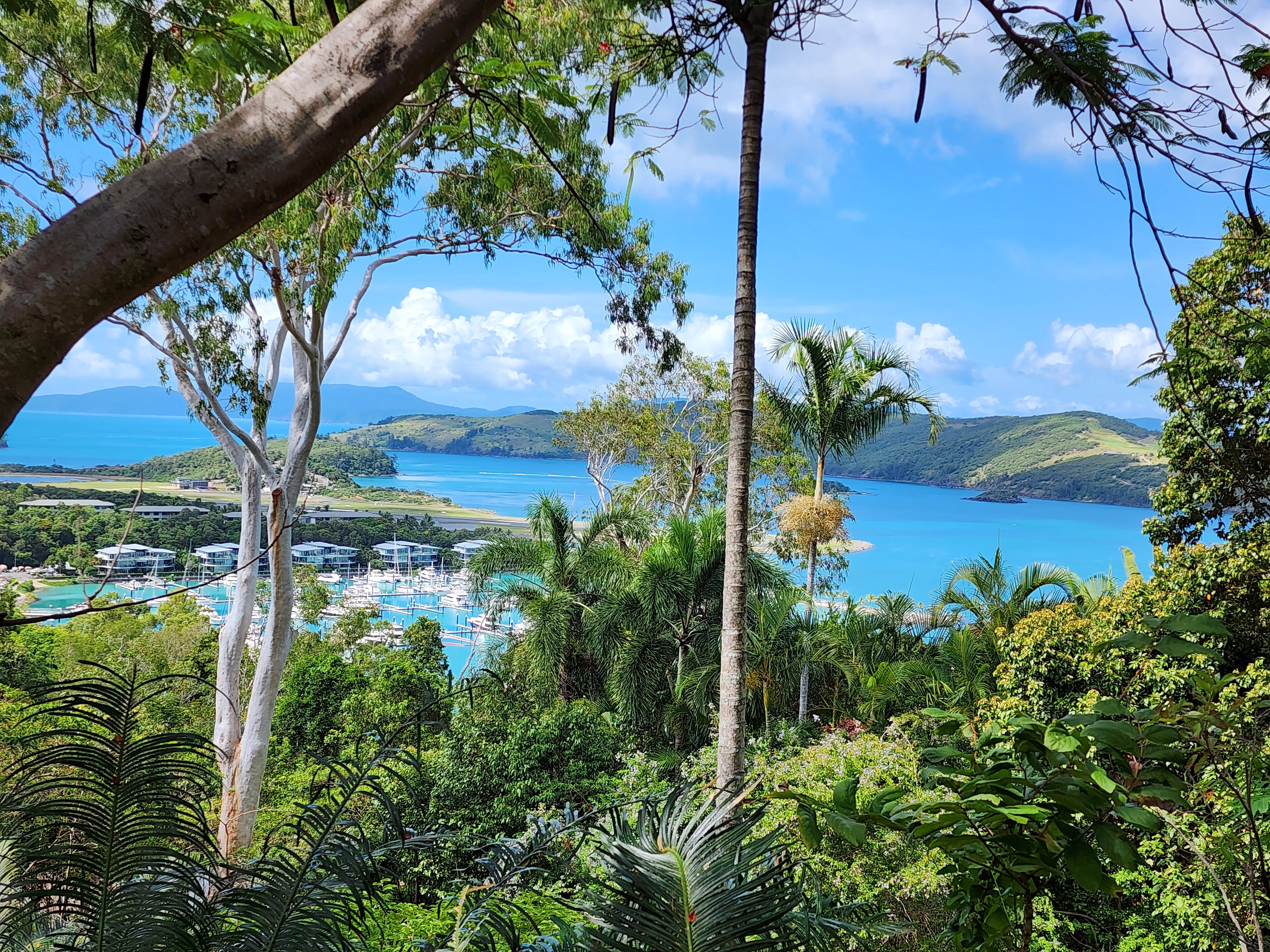
In 1987, Harrison built a compound on Australia’s Hamilton Island, near the Great Barrier Reef, including a main home and three guest huts. Visiting in 2007 (six years after Harrison died), Architectural Digest found a property rich with natural patterns and materials – incorporating a tree trunk found by George, bamboo ceilings, and a waterfall-fed pool, and decorated with Papua New Guinean artefacts. A curved window looked out onto lorikeets and cockatiels chattering amid the garden’s “dense tropical vegetation”.
‘How far away can I get’?
“George was always on a quest to get as far away as he could,” his widow Olivia told the article’s author, Paul Theroux. “We found Hawaii and built a house there. But he wanted to keep going. We went to Tasmania, New Zealand, Australia. I had the feeling that he maxed the planet out, looking for solitude. It was about ‘How far away can I get?’”
While George was clearly concerned about security, Olivia suggested this impulse had deeper roots, saying her late husband was “shell-shocked from the whole Beatle experience… Literally shell-shocked”.
She told Theroux:
“He hated loud noises. And imagine if all day, every day, for five or six years, people were screaming at you when you opened your door, jumping on the hood of your car, looking in your window. And then there were the death threats. He wanted to be far away. And he wanted sunshine.”
He wanted sunshine
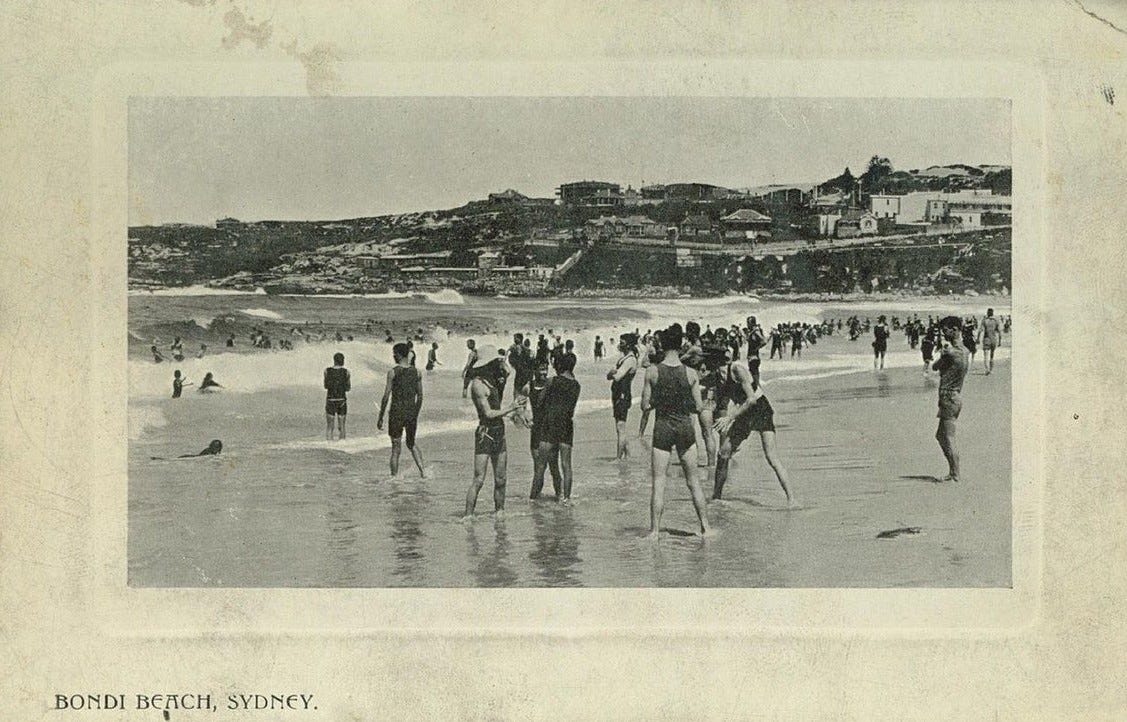
And perhaps George’s desire for escape went even deeper. Like John Lennon’s dad, George’s father Harry worked for a time in the merchant navy – bringing back tales and photographs from his exotic travels. Citing a 1986 interview George gave to the Australian magazine Good Weekend, Mark Lewisohn says the Beatle “would recall his dad showing him snaps of Pacific islands and Bondi Beach in the 1930s – told with stories of the Sydney shark nets and how he’d seen a shark amputate a swimmer’s leg”4.
These sunshine-filled stories must have contrasted vividly with the austerity of post-war Liverpool – with its rationing, bomb sites and homes without central heating. As Olivia told Paul Theroux, George would “have to chip the ice off the inside of the windows – the inside!”
Harrison hated his grammar school, which he said was “where the darkness began and I realised it was raining and cloudy with old streets and backward teachers and all of that”5. It seems George found this grimness as oppressive as he later found Beatlemania – and in both cases, he wanted to be far away. He wanted sunshine.
‘Modest seclusion’
Of all the Beatles, Harrison’s need for privacy was the most intense. But to some extent, his bandmates all shared it – at least according to their solicitors, who wrote in a surprisingly poetic section of their application for government permission to buy the island:
“You will readily appreciate that with their fame at the international level, it is nearly impossible for [the Beatles] to maintain even the most modest seclusion anywhere in the world and that in most places they are subjected to reporters and crowds of people and constant publicity.”
In hindsight, it’s hard to believe the Beatles would have considered anything as mad as living on an island together. But the group were always comfortable with outlandish ideas: most of their success came from them. They’d already achieved the improbable in bringing the sun to post-war Britain. Once they’d done so, they dreamed big again, imagining an escape to sunny Greece. The fantasy was never realised. But it was a powerful idea – and one by no means restricted to the mind of John Lennon.
Read more:


The Beatles Anthology (book), 2000
I, Me, Mine (1980), George Harrison
George Harrison: Behind the Locked Door (2013), Graeme Thomson
Tune In - extended special edition (2013), Mark Lewisohn
I, Me, Mine (1980)
For the most part the people of Maui respect their neighbors, regardless of name or wealth, and especially the land. I can see George's point, but he probably should have done more research about the environs to the property. Something else he could blame on Dennis O'Brien?