

My research on this Substack began with a Greek island, “Leslo”, that seemed not to exist. That puzzle led me to a number of other mysteries – including a famous Beatles quote that’s also proved remarkably hard to pin down.
According to numerous sources – ranging from national media publications to the UK government website – the British critic Kenneth Tynan described Sgt. Pepper’s Lonely Hearts Club Band, the Beatles’ 1967 album, as “a decisive moment in the history of Western civilisation”.
This striking claim about the album’s cultural significance is frequently repeated. But I’ve always avoided using it myself, mainly because I couldn’t find an original source for when Tynan said this – despite making a brief attempt to locate it in 1967 newspapers. I suggested to Obadiah Jones that he could research this mystery for his Beatles podcast Gimme Some Truth – and happily he’s got close to solving it.
As you can hear on the podcast, Obadiah’s efforts to track down the quote became a “wild goose chase” where books and articles endlessly cited each other without leading to an actual source. The first printed appearance of the phrase he found was in Philip Norman’s 1981 book on the Beatles, Shout!. But Norman said he couldn’t recall where it came from.
‘Misremembered or misquoted’?
The words also appeared in an article by Philip Norman in The Times in 1987, marking Sgt. Pepper’s 20th anniversary. Obadiah found that the wider use of the quote “exploded” around this time, leading him to conclude that Norman was the “primary source” for other writers.
But where the words originally came from isn’t an easy question to answer. As it turns out, Kenneth Tynan didn’t write a review of Sgt. Pepper at all upon its initial release – either for The Times (often cited as the publication) or for The Observer, the newspaper he actually worked for. However, Tynan did write in a January 1968 column for The Observer that “The Beatles’ Sgt. Pepper album was Britain’s most important contribution to the arts in 1967.”
As he researched the subject, Obadiah says it seemed “more and more likely” that Philip Norman could have “misremembered or misquoted this real Observer statement in Shout!”
He also found another statement – written by the journalist Langdon Winner in 19691 – that “the closest that Western civilization has come to unity since the Congress of Vienna in 1815 was the week that the Sgt Pepper album was released”.
Obadiah argues that “the best explanation” for the supposed quote is that “Tynan’s original Observer quote was fused with Winner’s statement” – placing the responsibility either with Norman or an “unknown previous source”.
From paraphrase to quote
It doesn’t help Norman’s case that in other instances in Shout!, he is demonstrably inaccurate, deploying what Obadiah describes as “fused and paraphrased” quotes. But looking closely at the alleged Tynan remarks, I noticed a significant evolution in how they were portrayed.
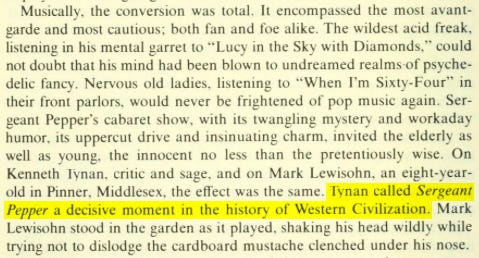
In Shout!, Norman writes that “Tynan called Sergeant Pepper a decisive moment in the history of Western Civilisation”. It’s a long way off what Tynan wrote in 1968, but in fairness to Norman, he doesn’t actually put the phrase inside quotation marks here. So in Shout!, he’s not necessarily claiming Tynan said these exact words (though it’s questionable whether even as a paraphrase, it accurately conveys the sense of them).
That has changed in Norman’s 1987 Times article – where the words have been upgraded from a dubious paraphrase into an apparent direct quote. It’s not clear, though, where exactly the quote marks are supposed to be: the words appear, confusingly, with three sets – as seen in the image below.
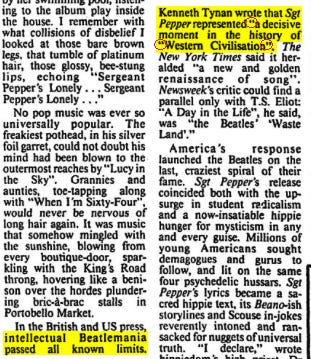
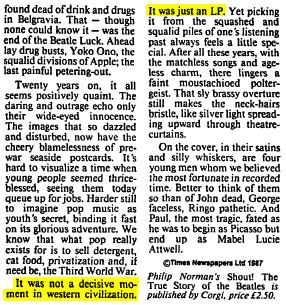
How and why the paraphrase became a quote is not known. But interestingly, the words are included in order to be undermined by Norman. He gives them as an example of “intellectual Beatlemania” passing “all known limits” – then later concludes that the album “was not a decisive moment in Western civilisation. It was just an LP.” Though Norman dismissed Tynan’s purported comments, the irony is that they were then ‘quoted’ widely elsewhere – and often approvingly.
How Beatles myths are made
For me, this issue is less about any one writer (or editor) and more about what the music critic Simon Frith described – in an email discussed in the podcast – as “a fascinating example of how myths are made”.
‘Myth’ is sometimes used to mean something that is false. But it can also refer to a story – whether literally true or not – with a particular hold over us. In this second sense, the Beatles are a mythical band, and Sgt. Pepper is arguably their most mythical album.
The power of Pepper was recognised upon its release, but in the following decades the record has been enshrined as a cultural icon. The words attributed to Kenneth Tynan have evolved in line with the album’s growing status: first a positive but measured assessment, then a much bigger alleged claim, then the same claim boldly stated as a quote.
Whatever Philip Norman thought, many would now argue that Sgt. Pepper was indeed a “decisive moment in the history of Western civilisation”: part of modernity’s founding mythology. And that helps explain why those words have stuck – despite the unlikelihood that Kenneth Tynan, or anyone else at the time, wrote them.
For a deep (but only 20-minute) dive into Kenneth Tynan’s love of Sgt. Pepper and the origins of the supposed quote, I’d recommend listening to the full podcast episode.
You can also listen to my earlier guest appearance on Gimme Some Truth discussing the Beatles’ 1967 visit to Greece and dream of buying an island.
Read more:


In the essay The Strange Death of Rock and Roll, published in Greil Marcus’ 1969 anthology Rock and Roll Will Stand
Philip Norman wrote and published 'Shout!' at a time when there hadn't been a serious Beatles biography in years. As it was followed within a few years by Peter Brown's tell-all and a handful of Lennon bios with different agendas, it gained stature as definitive, when all it really was was another stab.
Luckily for us, one of his researchers was Mark Lewisohn, who has proven time and again to be more concerned with finding out the facts than Norman, who's coasted on his proclamations for decades, even extending them into four further Beatle bios of varying accuracy and attitude. His reputation among Beatlemaniacs has tarnished to the point where we wonder if any "new" info really happened.
Meanwhile, us younger Americans in the late '70s devoured Nicholas Schaffner's 'The Beatles Forever', which remains incredibly devoid of gross inaccuracies half a century after it was published.