

What if John Lennon had moved to New Zealand as a child instead of becoming a Beatle? In effect, this was the question that the majority of my writing focused on in 2025.
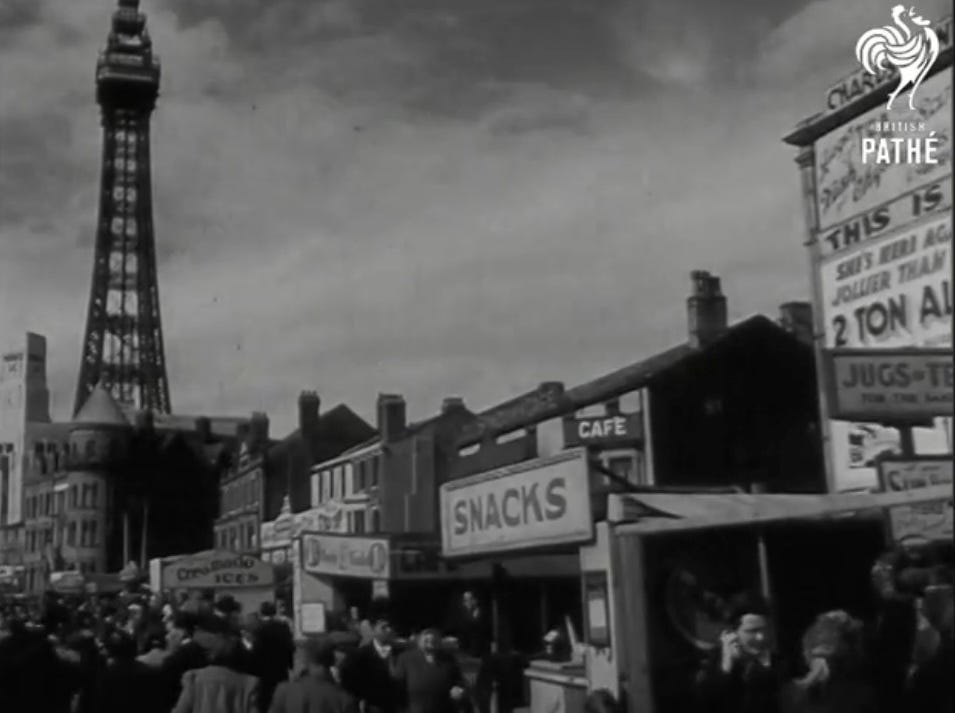
Many influential accounts of Beatles history have included a dramatic encounter in 1946. In the seaside resort of Blackpool, it’s said that John was asked to choose between moving to New Zealand with his father, Alf, or staying in Liverpool with his mother, Julia. In some versions, the five-year-old John initially chooses to go with Alf, before at the last minute running down the street to be with Julia.
We now know that the Blackpool story is at best an exaggeration. The initial reason for my interest in it was the possibility that the events may have influenced John’s later fascination with islands and the sea. But after researching it in more detail, I was intrigued by the way it developed over decades through interactions between different sources and writers. The decisive moment came when a retired businessman in New Zealand read a book review, and decided it was time to break decades of silence.
This post traces the rise and fall of the myth – and how our understanding of it continues to evolve.
1. Alf Lennon’s claims
The initial Blackpool story came from John Lennon’s father Alf, who in 1968 told Beatles biographer Hunter Davies that John “had to decide whether to stay with me or go with her”.
A more detailed version appears in a 1990 book – authored by Alf’s second wife Pauline, but “largely based on” his unpublished autobiography. The book, Daddy Come Home, claims that the plan was for John to first travel to New Zealand with the parents of Billy Hall – Alf’s friend from the merchant navy, who he and John were staying with in Blackpool. Alf and Billy would then join them there later, by working a passage to the antipodes and then ‘jumping ship’ – a common practice at the time.
Alf’s basic claim about the choice that faced his son was repeated in books by people close to John: his first wife Cynthia, and his former personal assistant Fred Seaman. But as far as I know, John never commented directly on it himself. This, as well as general scepticism about Alf Lennon’s reliability, mean some doubts have always remained about what actually happened.
2. The Norman biography
Due to its appearance in Hunter Davies’ authorised biography, many were familiar with the basic Blackpool story; the more elaborate version involving the Hall parents was less well-known. This changed with in 2008, with a new biography of John Lennon by Philip Norman.
Based on Alf’s account, Norman wrote that – after returning from a voyage in 1946 amid the uncertainty over John’s care – he “decided he had no alternative to abduct his son”. Alf paid a visit to the house of John’s aunt Mimi (where John was staying). Under the pretences of making a day trip, he then left with his son to Blackpool, where he “hid out” at the Halls’ house for about three weeks.
Alf initially planned for John to stay with the Halls when he returned to sea. But after learning that they planned to emigrate to New Zealand, “a more complex scheme took shape”:
“Mr and Mrs Hall would take John with them, posing as his grandparents; a little later, Alf, Billy Hall, and Billy’s brother would obtain their own passage to New Zealand free of charge by signing on to some Australasian-bound liner, then jumping ship when it reached Wellington.”
3. ‘Kidnapping’ story and Billy Hall’s intervention
The dramatic account in Norman’s book was highlighted in a review the same year by a New Zealand journalist, Steve Braunias. Based on the book’s claims, Braunias envisioned a world where rather than becoming a Beatle, Lennon had ended up as an ageing suburban Kiwi – “a thin-haired, short-sighted old duffer issuing flat New Zild vowels through his snoot”.
Again based on the book, the article said John’s “dad Alf kidnapped him, and took him to Blackpool, where friends – the Hall family – prepared to emigrate to New Zealand”. (See here for the text of the article, originally published in November 2008: John Lennon, almost a Kiwi.)
One person that Braunias’ review reached was Billy Hall – who, unlike his friend Alf Lennon, did actually move to New Zealand in the 1940s. Reading about the alleged plan to abduct John, he wanted to correct the record. Braunias recalled to me that Billy’s wife got touch with him after the review was published, saying “I think you need to speak to my husband”.
Braunias interviewed Billy (by then known as Bill) Hall, who after emigrating had become a successful businessman. In an interview published in the Sunday Star-Times newspaper on 8 March 2009, Hall described Norman’s account of the Blackpool events as “bullshit”.
4. Tune In
The renowned Beatles biographer Mark Lewisohn told me his account of what happened next. He said he’d been trying to find Hall for years, focusing his efforts on New Zealand - but had given up. Then after the interview with Bill Hall was published, he was alerted to it by another researcher1. Lewisohn contacted the publication, and conversed with Braunias, who “kindly paved the way” for him to speak to Hall.
Lewisohn then interviewed Bill Hall, in two long phone conversations, on 6 April 2009. Bill’s comments on the Blackpool events are included in Tune In (2013) – the first of Lewisohn’s planned three-volume Beatles biography. Hall told Lewisohn that there was “definitely no tug-of-love scene”, and “no truth at all” in the supposed plan that John would emigrate with Bill’s parents:
“I said I would go to New Zealand, and Lennie (Alf] said he might too, and also another mate of ours, and it some point it was mentioned that it would be a great place to raise Johnny – but no plans were ever made. Not only were my parents not planning to go, they didn’t even know I was.”
5. Untangling Alf Lennon’s yarns
The account of the events in Lewisohn’s book adds further important information to the story. But after reading this and other accounts, I still had some questions. Although Bill Hall categorically denied the claim about his parents planning to take John to New Zealand, it still wasn’t clear what exactly did happen. By his own admission, Bill wasn’t in the room where the key conversation between Alf and Julia took place, and there seemed to be some inconsistencies in his account, as well as Alf’s.
By looking at ships’ records in the National Archives (which as far as I know, Lewisohn didn’t consult for Tune In), I was able to establish more certainty about what Alf Lennon did during the war, how he and Bill met, and when Bill emigrated. The records indicated that Bill was a considerably more reliable source than Alf, who seemed to have simply invented parts of his story. But they also left open the possibility that Alf may have considered following Bill to New Zealand.

Historiographical complexity
The chronology above highlights how Bill Hall’s testimony was crucial to correcting an inaccurate narrative – but it’s also crucial to understand that he wasn’t a passive source, waiting to be discovered. Prompted by the account in Norman’s book, he actively chose to contact Braunias so he could tell his side of the story. Braunias’ interview with Hall was published in March 2009. Following this, Braunias facilitated an introduction between Lewisohn and Hall - who Lewisohn interviewed in April 2009.
On BlueSky in April 2025, Lewisohn wrote that he “found Billy in 2009… And I got to the truth just in time”. But as he’s since confirmed, this isn’t the whole story - and the full context matters for how we interpret Hall’s testimony.
I agree with the Beatles historiographer Erin Torkelson Weber that on this issue, Alf Lennon had a more obvious agenda than Bill Hall2. But Bill did have an agenda: to clear his and his family’s name from the alleged plan to abduct John. So in my opinion, I don’t think it’s necessarily true that (in Lewisohn’s words in Tune In) Hall “relate[s] the events impartially” – and this definitely shouldn’t be assumed.
One area, for instance, where I have some questions about Bill’s account is in his reported claim to Braunias that his parents “never had any idea of coming to New Zealand”. This contradicts what Bill Hall’s children told me: that Bill’s parents did move to New Zealand – years after he did, but certainly before he spoke to Braunias. In his enthusiasm to challenge Norman’s “bullshit”, perhaps Bill Hall was selective in the truth he told.
See the links below for more detail on the Blackpool events and Lennon’s interest in islands. And subscribe to Follow the Sun to receive articles in 2026 on Magic Alex, the Beatles’ visit to Greece and more.


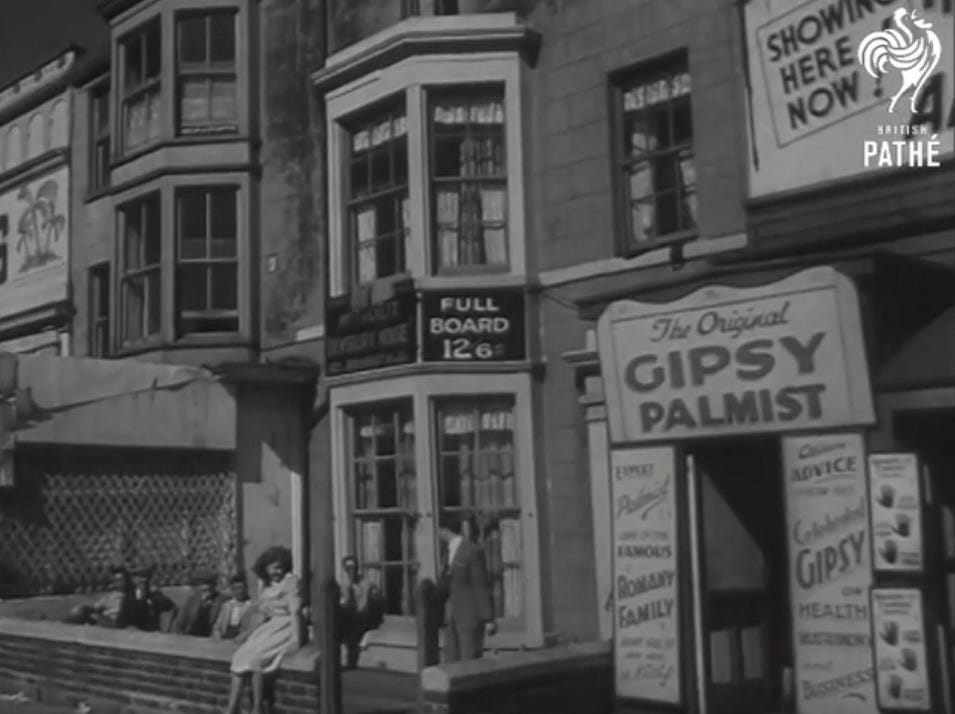
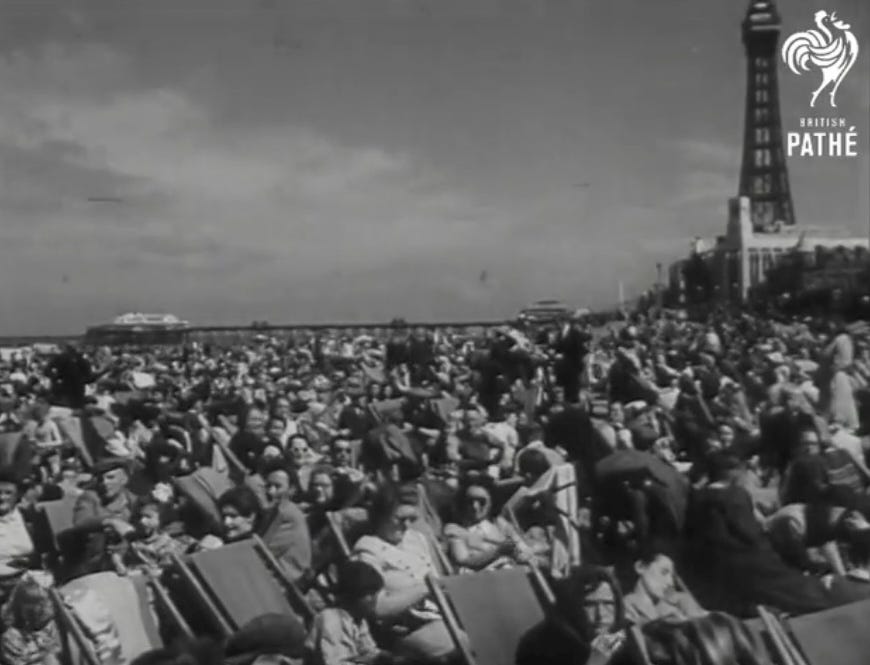
Several images in this post are from Pathé Pictorial Goes to the Seaside: Blackpool (1947)
Andy Neill, co-author of When We Was Fab: Inside the Beatles Australasian Tour 1964
The Beatles and the Historians: An Analysis of Writings About the Fab Four (2016)
Well done yet again, sir. One thing is clear from all the accounts: John had lousy parents.