

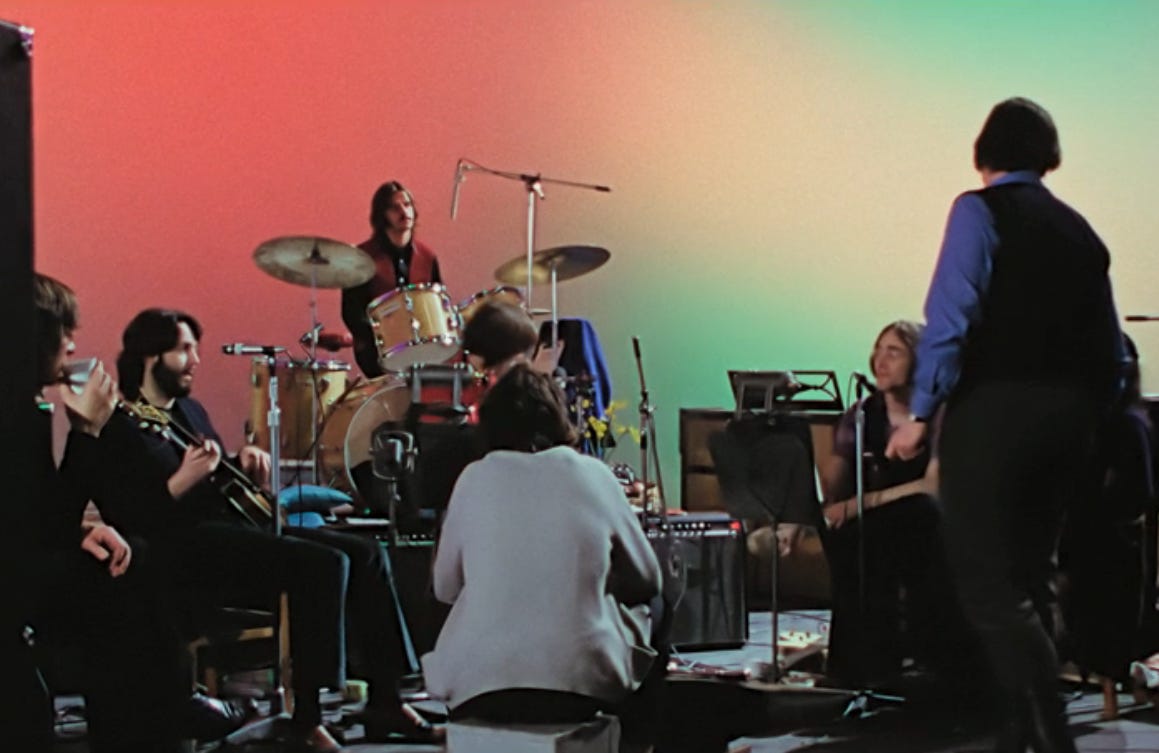
The recent appointment of four new executives at Apple Corps – the company which manages the Beatles’ creative and business interests – signals big ambitions for the Beatles’ global brand.
The hires were announced as Sam Mendes’ “four-film cinematic event” approaches in 2028 – reflecting an expectation for his Beatles biopics to generate huge interest. In keeping with the group’s profile, the new executives have all worked for massive cultural brands – with the names Harry Potter and Warner Bros. recurring repeatedly on their CVs.
Lux Paterson joins as chief strategy and marketing officer from Warner Bros. Discovery, where she “led growth strategies for global franchises”. And new chief finance and operating officer Jemma Hill arrives from the Blair Partnership, where she had responsibilities for various businesses associated with Harry Potter author JK Rowling and her agent Neil Blair.
The appointment of Jonathan Sands to the executive team is particularly intriguing given his remit to “focus on Apple Corps’ ambitions in visitor experiences and retail”. Sands has previously run a number of “experiential businesses”, including the London Film Museum – which hosted an exhibition of cars used in James Bond films – and the Harry Potter shops found at UK transport hubs such as Heathrow Airport.
Miranda Langford, meanwhile, joins as head of marketing from Paul McCartney’s MPL. The new appointments will work under chief executive Tom Greene – appointed last year – who has also previously worked for the Harry Potter franchise. Greene said the recruits will help the company seize “huge” opportunities, fulfilling “the ambitions we have for a seismic period in Apple Corps’ and The Beatles’ history”.
Shaping the legacy
The Harry Potter franchise encompasses a vast tourism ecosystem, from the Warner Bros. Studio Tour to West End theatre and themed afternoon teas. Whether Apple seeks to emulate this approach – and what kind of Beatles “experiences” it has in mind – remain unknown. But Greene is right to highlight this as a significant moment. Paul and Ringo are now well into their eighties, and the 1960s are receding from living memory. The coming years will indeed be “seismic” – not just for the Beatles’ commercial prospects, but also for how they are perceived by future generations. In this light, Mendes’ films – following on from 2021’s Get Back and last year’s rebooted The Beatles Anthology – will play an important role in introducing new audiences to the band and influencing their perceptions of them.
The retrospective mood extends beyond Apple’s corporate walls to the individual Beatles. Paul McCartney’s new album, due later this month, will focus firmly on his past: the “smoky bars and cheap guitars” of his youth in post-war Liverpool. We’re told Paul has written “with openness” about these early experiences – though on the single already released, he also promises to honour a “secret code” he and John Lennon wrote together. In any case, The Boys of Dungeon Lane – which features a duet with Ringo Starr – underlines how understanding the Beatles means understanding where they came from. As Paul says: “I do often wonder if I’m just writing about the past but then I think how can you write about anything else?”
Another important Beatles milestone is coming into sight with Mark Lewisohn’s recent comment that “there’s a chance” he will have finished the second volume of his monumental band biography by 2031. Lewisohn has set out his ambition to influence people’s comprehension of the Beatles – saying that if he doesn’t get their story right, it risks being “misunderstood and wrong forever”. Like his first instalment, 2013’s Tune In, the second will no doubt be widely acclaimed. It may also be more controversial – covering a more complex part of the Beatles’ story, with more scope for differing views and interpretations.
Revolution in the head
Lewisohn has justified his decades-long dedication to researching the Beatles by comparing the group’s cultural significance to Shakespeare or Mozart. And this is one area where there is growing agreement. In his 2025 book John and Paul, Ian Leslie also likens the Beatles’ impact to that of the bard. Referencing Harold Bloom’s argument that Shakespeare didn’t just represent human nature but reimagined it, he writes that “the Beatles were crucial to the creation of a post-1960s personality”. If so, then the world’s ongoing fascination with them makes sense – and is likely to continue.
I started researching the Beatles’ dream of buying a Greek island through simple curiosity – but as my interest in the story has grown, I’ve had to reflect on why this is. The more I learn about the group, the more I think there must be a reason they prompt such intense responses in every generation. And I suspect this ultimately has less to do with Apple’s marketing than the way the Beatles radically redefined norms – refusing, as Paul McCartney suggested in 1967, to “shut themselves in” with rules that were “just not true any more”. This attitude was at the heart of what Ian MacDonald called the 1960s’ “revolution in the head”, in his 1994 book on the Beatles. And the enthusiastic response Paul’s comment received when I posted it on Instagram suggests it still chimes widely today (as does Paul’s moustache).
In the end, though, the power of creative genius is not easily understood or defined. McCartney’s album, Mendes’ films and Lewisohn’s book will all contribute to a renewed appreciation of the Beatles’ achievement. But it may take many more years – or decades – before we can really grasp what it means.
Read more:


Unrelated, and am catching up on your posts, but have you addressed anywhere the basic craziness of the idea of spending the huge amount of money they were going to shell out and of living together when Paul was Mr. Man About Town in London and John was unhappy in his marriage? I suspect Paul was just letting John get another wacky idea out of his system without being committed to it, that Ringo would have been happy playing with his toys anywhere, and that George and John were more or less drug addled (though I guess George had or was about to renounce LSD). John was naively trusting his guru Alex. Maybe George was still willing to do whatever John wanted. Perhaps they felt it was easy enough to fly back to London as necessary, though the travel logistics would have been significant. It just seems mad (particularly for Paul).